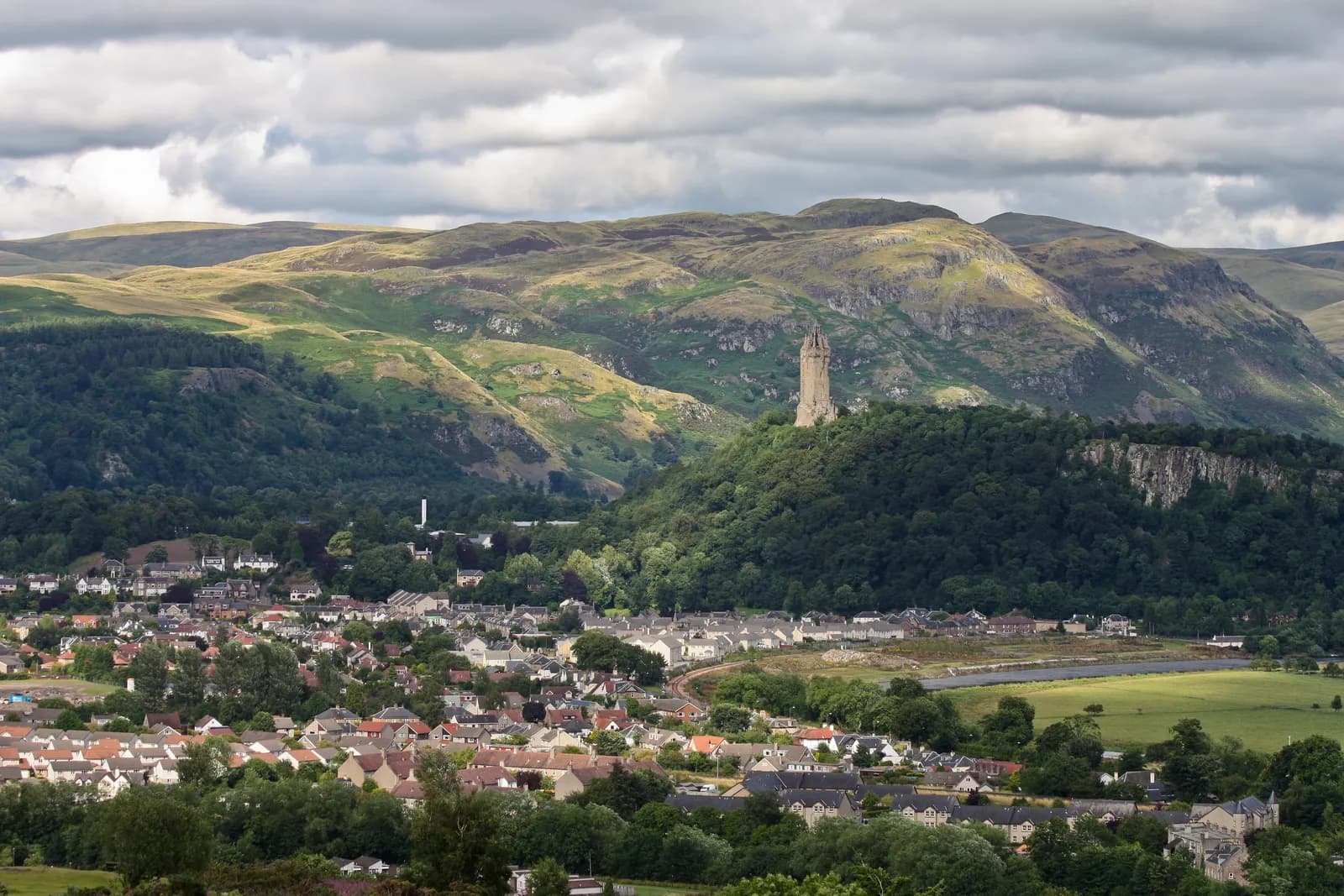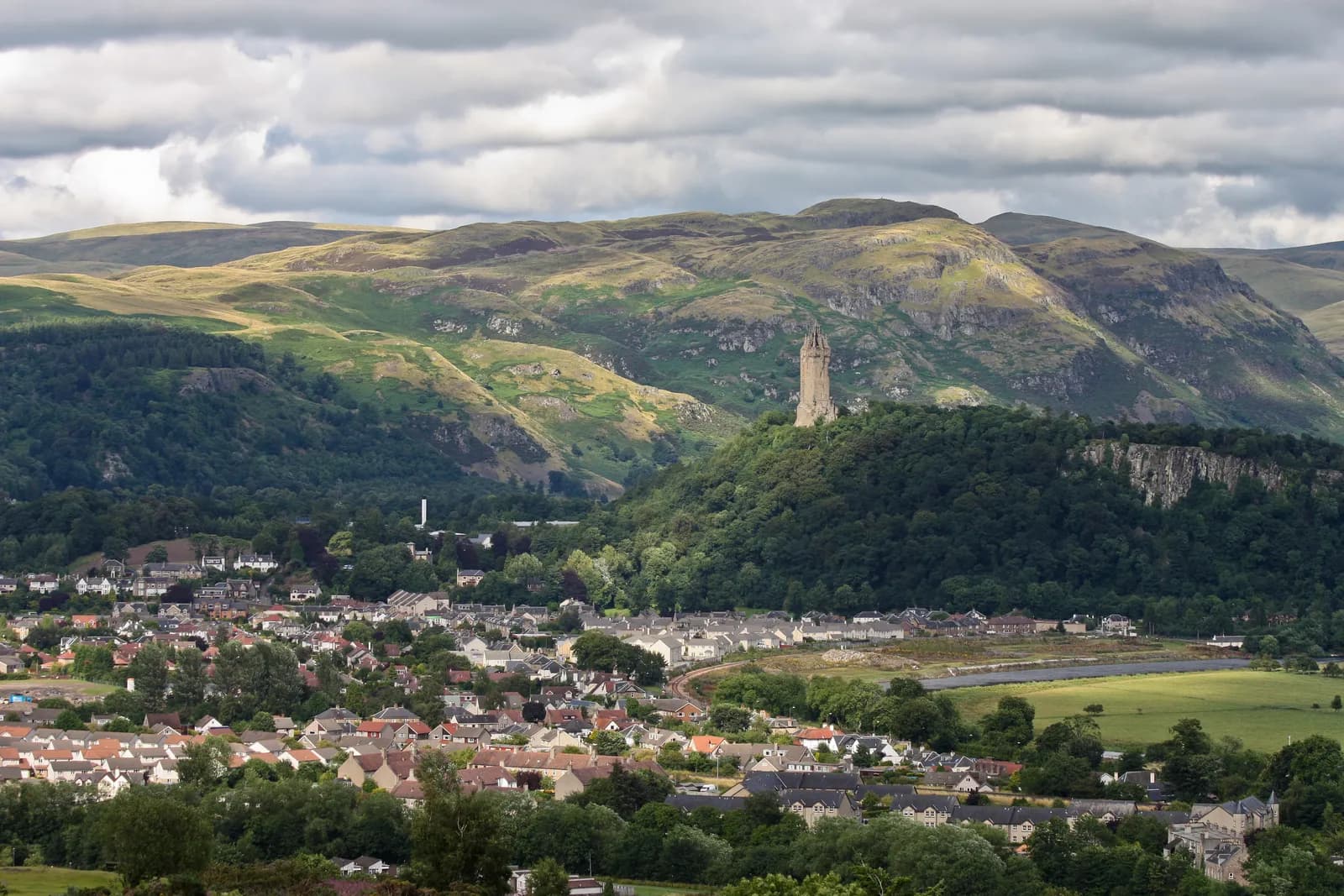
Rising 67 metres above Abbey Craig, the National Wallace Monument stands as one of Stirling's most recognisable landmarks. Yet this imposing sandstone tower, visible from across the Forth Valley, was not built to commemorate the medieval warrior himself, but to manufacture a Victorian national hero.
A Campaign Born in the Drawing Rooms of Glasgow
The monument's origins trace back to 1851, when the Reverend Charles Rogers, then chaplain at Stirling Castle, launched a public subscription campaign from Glasgow. His ambition was straightforward: to erect a memorial to William Wallace that would secure the medieval knight's place in Scotland's pantheon of national heroes. Over the following years, Rogers wrote more than 20,000 letters to potential donors. The campaign drew support from across Scotland and beyond, including a notable contribution from Italian nationalist leader Giuseppe Garibaldi.
Rogers resigned around 1855, passing leadership to William Burns, a Glasgow lawyer and vocal Scottish nationalist. The project gained momentum, and in 1859 architect John Thomas Rochead won an anonymous design competition with an entry signed "nothing on earth remains but fame." His Victorian Gothic vision would take a decade to realise.
Laying the Foundations of Myth
The foundation stone was laid on 24 June 1861, the anniversary of the Battle of Bannockburn. An estimated 80,000 people travelled from across Scotland and beyond to witness the ceremony, at which the Duke of Atholl officiated as Grand Master Mason of Scotland. Sir Archibald Alison delivered a short speech.
The tower would not be completed until 1869, and its construction was not without difficulty. The project ran £5,000 over budget, bankrupting the contractor. Rochead himself was never paid his full fee. Yet the result was striking: a 220-foot sandstone tower, accessed by 246 spiral steps, crowned with a viewing gallery offering panoramic vistas across the Ochil Hills and Forth Valley.
The monument opened to the public on 11 September 1869, exactly 572 years after Wallace's victory at the Battle of Stirling Bridge.
Why Stirling, Why Then?
The choice of location was deliberate. Abbey Craig, the volcanic hill on which the monument stands, was Wallace's headquarters before the battle of 1297. From this vantage point, he watched the English army gather across the River Forth. Stirling had been chosen over Glasgow and Edinburgh precisely because of this connection to Wallace's greatest military achievement.
The timing was equally significant. The mid-19th century saw a resurgence of Scottish national identity, fuelled by Romantic literature and the "hero worship" movement. Walter Scott's novels had rekindled interest in Scotland's medieval past, while Blind Harry's 15th-century poem The Wallace, Robert Burns's "Scots Wha Hae" (1793), and Jane Porter's The Scottish Chiefs (1810) had kept Wallace's memory alive in popular culture. The monument represented the physical culmination of this cultural movement: the transformation of a medieval freedom fighter into a romanticised Victorian icon.
The Hall of Heroes and the Codification of Scottish Greatness
In 1886, the monument's Hall of Heroes opened, establishing what amounted to a national pantheon of Scottish achievement. The first busts installed were of Robert Burns, donated by Andrew Carnegie, and Robert the Bruce, donated by the Marquess of Bute. By 1907, sixteen busts lined the walls. Today there are eighteen, including figures such as Adam Smith, James Watt, David Livingstone, and Thomas Carlyle. Only in 2017 were the first women added: missionary Mary Slessor and landscape architect Maggie Keswick Jencks, following a public vote.
The same year saw the installation of eleven stained glass windows by James Ballantine & Son, at a cost of £210. In 1888, the Wallace Sword, a 1.63-metre longsword first recorded at Dumbarton Castle in 1505, was moved to the monument. The original Victorian bronze statue of Wallace, standing twenty feet tall and created by David Watson Stevenson, was unveiled on 25 June 1887.
From Victorian Monument to Modern Landmark
The Wallace Monument's role in shaping Wallace's popular image cannot be overstated. It crystallised his status as "Scotland's National Hero" at a time when Scottish identity was being redefined within the Union. The tower became a site of pilgrimage for Scottish nationalists and tourists alike.
Visitor numbers remained steady at around 80,000 annually for much of the 20th century. Then came the "Braveheart effect." Following the 1995 film's release, annual attendance peaked at 184,265 in 1998. For the decade 1996 to 2005, the average exceeded 135,000 visitors per year. The monument's operators estimate the film generated at least £25 million for Stirling's local economy.
Today, the monument remains one of Stirling's premier attractions, operated by Stirling Council. It is a Category A listed building, designated in 1965. The 246-step climb remains inaccessible to disabled visitors, a limitation that has drawn criticism in recent years.
What Remains
The Wallace Monument stands as testament to Victorian Scotland's desire to claim its past. Built through public subscription, designed in the Gothic Revival style, and situated on the very hill from which Wallace surveyed his enemy, the tower did not merely commemorate history; it manufactured legend.
Wallace the man, executed in London in 1305 after serving as Guardian of Scotland, became Wallace the symbol: a romantic figure of resistance, national pride, and Scottish identity. The monument gave that symbol physical form. Nearly a century and a half after its completion, it continues to define how Stirling, and Scotland, remember their most famous medieval son.