John Cowane, a Stirling merchant who lived from approximately 1570 to 1633, left behind an architectural legacy that Historic Scotland describes as "one of the finest buildings of its kind in Scotland." His bequest of 40,000 merks established Cowane's Hospital, an almshouse that has served the burgh for nearly four centuries and earned him the enduring nickname "Auld Staneybreeks."
A Stirling Merchant's Rise
John Cowane was born into a family of Stirling merchants who had traded with the Dutch since the early sixteenth century. His grandfather supplied the royal court of James V at Stirling Castle, exchanging fish, coal, and wool for luxuries including prunes, saffron, and spices.
Cowane attended the grammar school that now forms part of the Portcullis Hotel before apprenticing in his father's booth on Broad Street. He established himself as a successful merchant, money lender, and shipping investor, eventually becoming a substantial landlord within the burgh. Contemporary accounts suggest he may have "indulged in a little piracy" alongside his legitimate trade.
His civic career was equally distinguished. Cowane served on Stirling town council and was elected Dean of Guild in 1624. He sat in the Parliament of Scotland from 1625 to 1632 and served as Commissioner to the convention of royal burghs.
A Scandal and a Bequest
Despite his prominence, Cowane's personal life was not without controversy. In 1611, he was fined £6 for fathering an illegitimate child. The child's mother was also fined and forced to undergo public penance; Cowane bought himself out of this requirement. He never married and lived with his sister Agnes at the family home on St Mary's Wynd, a building now known as John Cowane's House and preserved as a ruin by Cowane's Hospital Trust.
When Cowane died in 1633, he left the bulk of his fortune, 40,000 merks, for "ane hospital or almshous" to house "twelve decayed (elderly) guild brethren" rent-free. A merk was worth two-thirds of a Scots pound, or approximately one English shilling. He also bequeathed 500 merks to the Church of the Holy Rude.
Building the Hospital
The Deed of Foundation was signed on 13 February 1637 by Alexander Cowane, John's brother and executor. The land, located on St John Street between the Church of the Holy Rude and the Old Town Jail, was transferred to Stirling Town Council.
Royal master-mason John Mylne designed the hospital, with construction carried out by master-mason John Rynd. The building shows clear Dutch architectural influences, including a bell tower and crow-step gables that reflect Stirling's trading connections with the Netherlands.
Construction began in 1637. Existing buildings on the site were demolished and the ground levelled by burning peat to shatter the underlying rock. The hospital was completed in 1643, though it may not have been fully finished until 1660 and remained unoccupied until at least 1661.
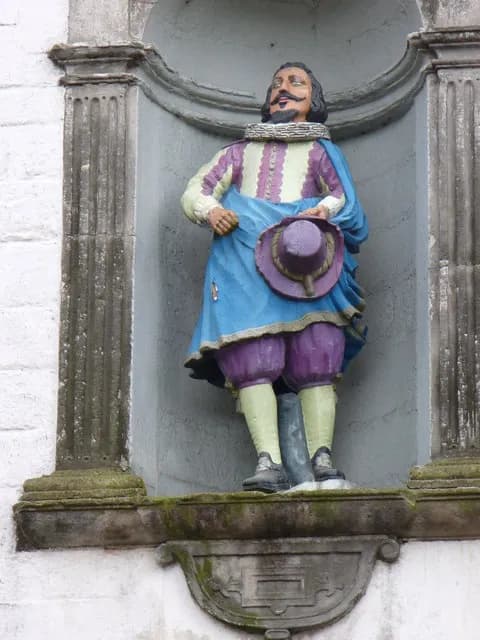
A statue of John Cowane, sculpted by John Mylne and William Ayton, was placed in a niche on the tower. This statue would give Cowane his lasting nickname.
Auld Staneybreeks
Locals dubbed the statue "Auld Staneybreeks" or "Auld Staneybreaks" — old stone trousers — a reference to its carved attire. The nickname passed to the man himself, and a legend emerged that the statue comes to life and dances in the courtyard at Hogmanay. As Cowane's Trust notes, "John Cowane still keeps an eye on the almshouse that bears his name – his statue, known as Auld Staneybreaks, looks down on the courtyard."
Gardens and Conversion
The hospital's gardens were laid out in the 1660s with ornamental, vegetable, fruit, and herb gardens arranged on terraces overlooking the Carse of Forth. William Stevenson, appointed gardener in 1667, ordered plants from Holland including apricot, peach, and almond trees. An elaborate carved sundial was erected in 1673.
In 1712, Thomas Harlaw, gardener to the Earl of Mar, drew up new plans for the gardens. A bowling green was laid out with balustraded terraces and Dutch-style parterres.
Around 1720, the building was converted to a Guildhall by removing internal partitions. It has served this function ever since, and the Stirling Guildry continues to meet there today.
Cholera and Conservation
The building's history reflects the changing fortunes of the burgh. In 1832, it served as an isolation hospital during a cholera epidemic that killed approximately one-third of Stirling's population. In 1852, the interior was altered by burgh architect Francis Mackison in the Gothic Revival style, with a new roof, timber gallery, and panelling added.
Cowane's Hospital has been a Category A listed building since 1965. The gardens were included in the national Inventory of Gardens and Designed Landscapes in 2012 as a "rare survival" of a seventeenth-century institutional garden.
The Hospital Today
A major conservation project began in April 2019, with the statue restored in 2020 and works completed in December 2019. The building is now run by Cowane's Hospital Trust as a venue for events, with free admission to the John Cowane exhibition and gardens. The trust also maintains the Merchant Guildry of Stirling's artefacts on display.
John Cowane's House on St Mary's Wynd, purchased and preserved by the trust in 1924, and his grave, restored in 2022, provide further tangible connections to the merchant whose generosity created one of Scotland's finest surviving examples of seventeenth-century burgh architecture.